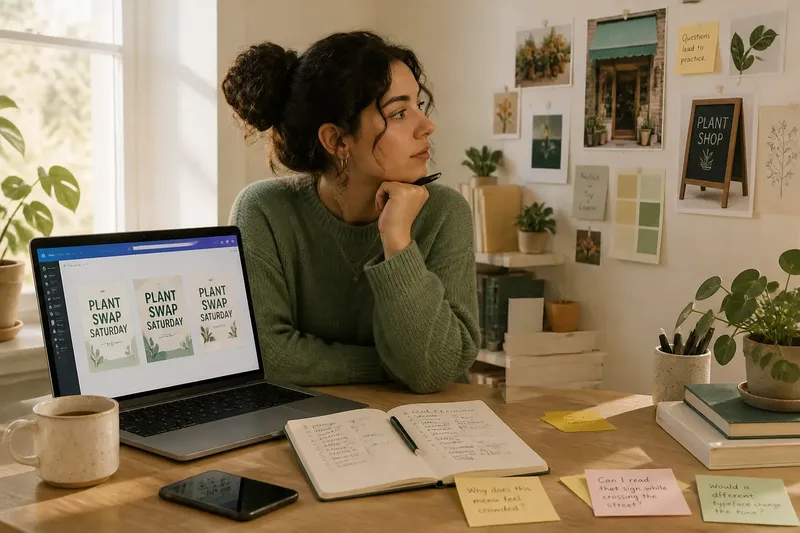
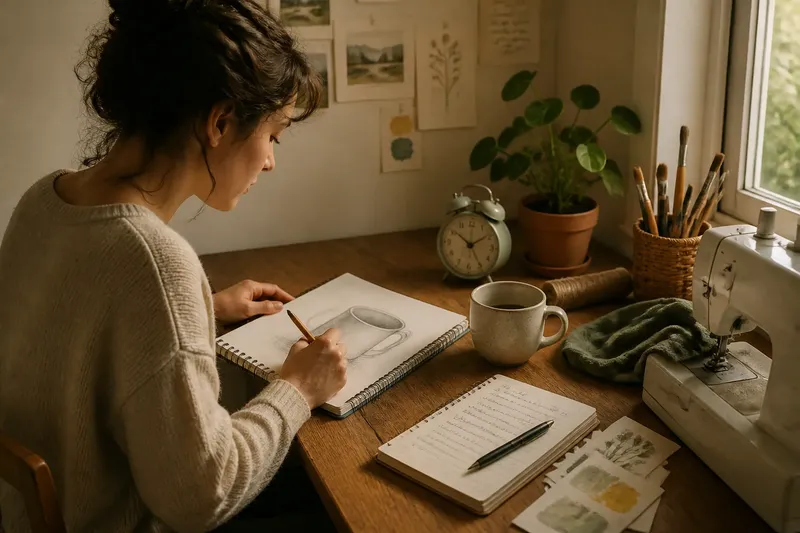
The Portfolio Does Not Need to Show Everything
A focused portfolio helps viewers understand your choices, range, and creative thinking without asking them to sort through every piece you have made.
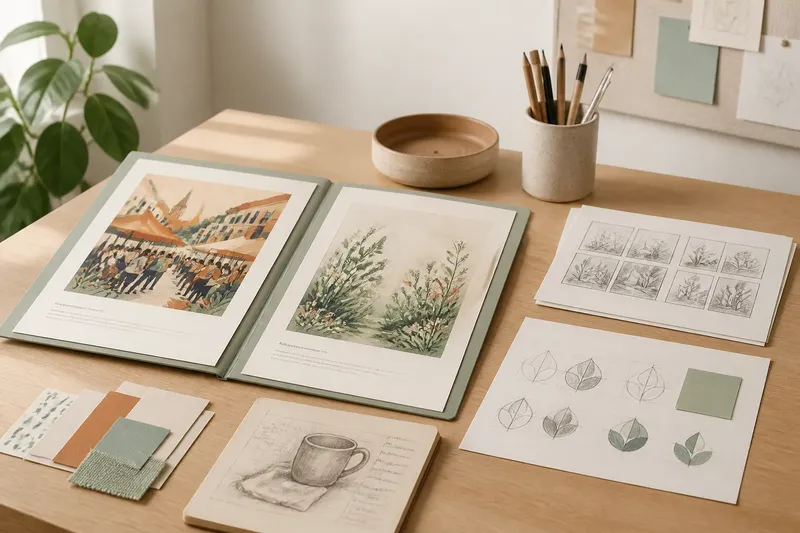
You spread your work across the kitchen table: a polished poster, three half-finished sketches, an old class assignment, and the object you keep making excuses for. A portfolio does not need to show everything on that table. A thoughtful selection gives viewers a clearer sense of your creative work—and gives each piece room to explain what you notice, choose, and make.
What does a portfolio selection actually show?
A portfolio is more than a storage place for finished work. It is a sequence of decisions. What you include, what you leave out, and how you arrange the remaining pieces all shape the impression a viewer takes away.
That does not mean every item must demonstrate a single, perfectly consistent style. The stronger thread may be your way of solving problems: how you use color to guide attention, simplify a complicated shape, or adapt an idea for a different material. A selection can show that thread more clearly than a complete archive.
Think of each piece as evidence of a particular choice, not a trophy that has to prove you are talented. One project might show careful observation; another, playful experimentation. Together, they can reveal a maker who is curious and deliberate, even if the objects look quite different.
How do you choose what earns a place?
Start by asking what a viewer should understand about your work after looking through the collection. Keep the answer plain and specific: perhaps you make illustrations that turn dense information into inviting images, or you build small objects from reused materials. This is not a slogan you have to print on a cover. It is a filter for making choices.
Then look through your work and note what each piece offers. A quick inventory can be as simple as a page in a notebook with the title of the piece and a few words about its strongest quality. Separate the qualities that appear from the ones you hoped would appear. That small distinction keeps affection for an idea from doing all the selecting.
Imagine you are assembling a portfolio of illustrations for community projects. You have a lively market poster, a quiet drawing of a garden, and several variations on a logo you no longer like. You might keep the poster for its clear visual hierarchy and the garden drawing for its attentive detail, then leave out the logo variations because they repeat the same lesson. The expected result is a collection with visible range and a more legible point of view, not a record of every afternoon spent drawing.
As you decide, consider these questions:
- Does this piece show a choice? Keep it if a viewer can see a distinct approach, material, or solution.
- Does it add something the others do not? A second example may belong if it develops a different side of the same skill.
- Can you explain its place honestly? A concise note should clarify context, not make excuses for a result you do not want to stand behind.
- Does it support the impression you want to give? A technically impressive piece can still distract if it points toward work you do not want to pursue.
- Would removing it make the collection easier to understand? If so, let it go for now; you can keep it in your archive.
How can a portfolio show the thinking behind the work?
A finished image or object may conceal the decisions that made it. A small amount of context can make those decisions visible without turning the portfolio into a diary. Add a short caption with the material, purpose, and one meaningful constraint. For a poster, that might be the need to keep the event details readable from a hallway. For a ceramic form, it could be a request to make the piece easy to handle.
Process images are useful when they reveal a choice rather than simply proving that work happened. A page of thumbnail sketches can show how you tested different compositions. A photograph of a paper mock-up beside the finished piece can explain why you changed its scale. Choose only the process material that helps a viewer read the final work more accurately.
Be precise about your role, especially in collaborative work. If you made the illustrations while another person handled the layout, say so. Clear credit does not weaken the piece; it helps viewers understand which decisions and skills belong to you.
How many pieces belong in a portfolio?
There is no useful universal number. The right amount depends on the purpose, the viewer’s time, and how much variation your work needs to make its character clear. A short portfolio can be persuasive if each piece earns its place; a longer one can work when the projects develop distinct ideas rather than echoing one another.
For a general collection, look for a beginning, a middle, and an ending rather than a pile. Open with a piece that makes your direction easy to grasp. Follow it with work that adds a new quality or shows a different approach. Close on something that leaves a clear impression, not necessarily the most elaborate object you own.
Digital portfolios make restraint easier to practice. Put your strongest selection on the main page, then use a clearly named archive or project page for additional work that matters but does not belong in the first pass. In a printed portfolio, a brief contents page can serve the same purpose. The viewer should not have to guess which pieces you most want them to see.
What do viewers want to know about a portfolio?
Should a portfolio include unfinished work?
Include an unfinished piece only when its current state helps explain an idea, experiment, or direction. Label it plainly and say what you were exploring; do not present an incomplete result as finished work.
Should every piece use the same style?
No. A consistent sensibility can appear through subject, attention, material, or problem-solving even when the visual styles differ. Select variety that shows intention rather than variety added simply to prove you can do many things.
What if a favorite piece does not fit?
Save it in your archive and consider sharing it in a separate context where its strengths make sense. A personal favorite can matter deeply without being the clearest representative of the work you want this portfolio to communicate.
How often should you revisit a selection?
Review it when your goals change, when new work adds a genuinely different strength, or when an old piece no longer represents your current choices. You do not need to replace work just to make the collection look newly assembled.
What belongs in the archive instead?
Keeping a focused portfolio does not mean discarding the rest. Store older pieces, alternate versions, and experiments in a folder organized by project or date. That archive can help you trace how an idea developed and give you material to reconsider when a new opportunity calls for a different emphasis.
For the public-facing collection, let selection do its quiet work: make your choices easy to see, make your role clear, and leave enough space for the viewer to notice how one piece differs from the next. A portfolio does not need to contain your whole history. It needs to make the most useful part of that history visible.